wealth, all free and without responsibility.
Who could steal this from me?
No one!”
These are the words of Arthur Streeton,
one of the young artists who escaped the depression in Europe in the 1890s and settled in Curlew Camp, one of the established camps around our foreshores, in order to explore their environment and creativity. | |||
| Below is a photo of the same site, Curlew Camp, 120 years later. The point to be made here is that they look very similar and it's mainly because of the vigilance of residents, past and present, and the continuing role played by Mosman Council of valuing and protecting Mosman's historical and cultural flavour.
| |||
Showing posts with label Mosman history. Show all posts
Showing posts with label Mosman history. Show all posts
Saturday, July 29, 2017
Our foreshores remain in safe hands - thanks


Tuesday, October 11, 2016
HANDS OFF THE BEACH!
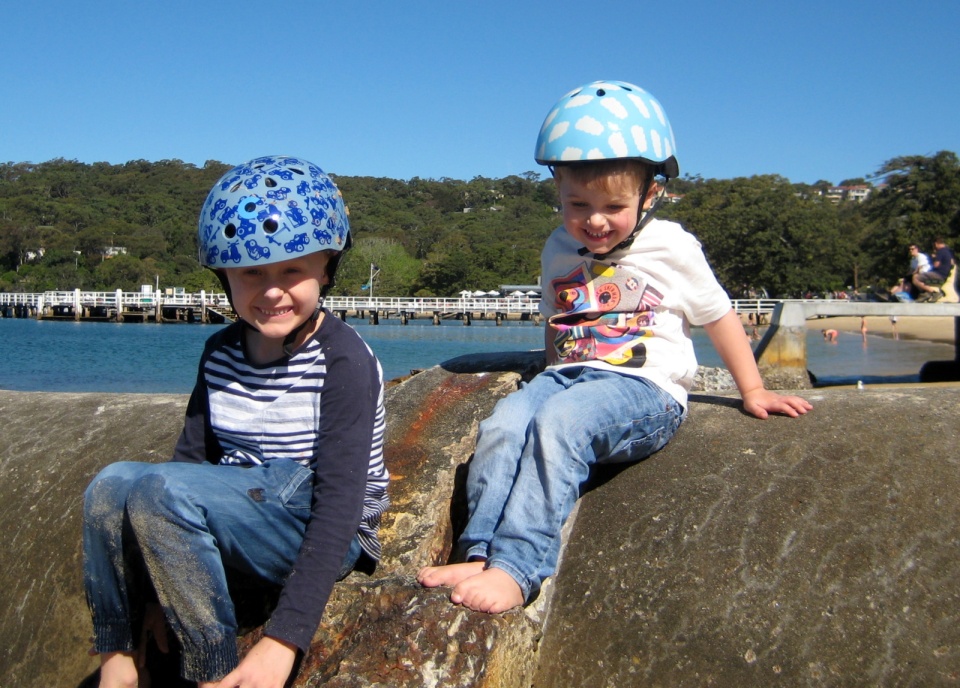
Balmoral Beach has to be the ultimate in fun for kids during the school holidays – scooting along the promenade, making friends with dogs, chasing seagulls, paddling and getting one’s clothes wet. Wonderfully simple, timeless activities which children have been enjoying for centuries. It’s even unnecessary (at the moment with our free parking) to have to dip into one’s pockets, except to buy the odd ice cream or drink.
History tells us that if the public had not rallied in the 1930s, there may have been a fenced-off area the full length of Edwards Beach which would have been revenue producing, with admission being charged to swimmers wishing to avail themselves to six acres of shark proof water.
There was public opposition to this council initiative and the outcry from residents was deafening :-
HANDS OFF THE BEACH! HANDS OFF THE BEACH!!
The protest was led by Julian Howard Ashton, a son of Julian Ashton, “We are not hostile to the Council. We are opposed to any scheme which will fence off the beach against the public.”
A compromise was reached in 1935 when the council accepted a tender for the steel net enclosure to be suspended between the Island and a tripod opposite the northern edge of the Pavilion.
A good model of ‘People Power’ and ‘Democracy in Action’.
For the love of Mosman– Claire
For information as to how you can play a part re Keeping Mosman Independent and therefore maintaining our favourite beach as it is, visit:-MAFA website, Mosman Against Forced Amalgamation. mafa2016.wordpress.com
Tuesday, January 27, 2015
SYDNEY FORESHORES' HISTORICAL & ARTISTIC LEGACY

Mosman Art Society exhibition, BUNGAREES FARM, highlights the historical legacy and the artistic worth of Middle head on Sydney's foreshores.
It is to be opened on 30th January by Mary Darwell, Executive Director of Arts NSW at the Camouflage Fuel Tanks-15 Dominion Crescent,
Middle Head, Sydney.
The exhibition, which, runs from Saturday 31 Jan to Sunday 8 Feb and is of contemporary Aboriginal audio, video, performance and installation art exploring Bungaree’s legacy.
It marks the 200th anniversary of the establishment of Bungaree’s Farm by Governor Macquarie on 31 January 1815.
It marks the 200th anniversary of the establishment of Bungaree’s Farm by Governor Macquarie on 31 January 1815.
For more information:-http://events.mosman.nsw.gov.au/events/989/bungarees-farm
 Bungaree, an Aboriginal man from Broken Bay, settled in Sydney in the 1790s. He became a familiar sight there, dressed in discarded military uniforms given to him by various governors.
He accompanied Matthew Flinders on two of his voyages of discovery and sailed with Phillip Parker King to north-western Australia in 1817.
.Macquarie and Bungaree were to become firm friends, where he proved very helpful in making contact with new tribes. Bungaree has been described as witty, intelligent, something of a diplomat and is recognized as an effective intermediary between colonists and Aboriginals.
Bungaree, 1826 Augustus Earle
Hand-coloured lithograph State Library
Settle and Cultivate From 'Mosman Meanders & foreshore flavours
The first settlers, convicts and military personnel were keen to farm the land and raise food, but their inexperience in farming techniques in the unfamiliar landscape resulted in near starvation due to early crop failures.
They were uninterested in traditional Australian agriculture, apart from some animals which they would shoot, fish, or catch. For the first 50 years, they imported most of their food from Mother England, until they managed to grow some of the vegetables they were used to back home.
They didn’t observe
Aboriginal harvesting or any traditional methods such as the use of fire
to flush out creatures. They did describe; that the ‘forests’
were, in general ‘entirely
free from underwood.’ The harbour clans shaped
their environment by creating particular habitats, as the result of the burning off process which promoted
certain fire-resistant species.
However, Phillip and
other officers quickly appreciated the significance of seafood for harbour
clans. In 1789, First Fleeter Watkin Tench description,” (They) Wholly
depend for food on the few fruits they gather; roots they dig up in swamps; the
fish they pick up along the shore, or contrive to strike from their canoes with
spears. Fishing, indeed, seems to engross nearly the whole of their time,
probably from its forming the chief part of subsistence.”
This understanding was
used to develop an important point of common interest, and therefore a currency
strategy, where fish became the most frequent exchange. Later rum became currency , in exchange for
produce from small farmers. It was consumed
in large amounts by the English and Irish who brought with them a love of
drinking – a culture we are said to have retained to this day.
Bungaree’s Farm
Bungaree’s Farm
In 1815 Governor Macquarie established
an Aboriginal-run farm, the exact boundaries of
which are uncertain. However, in 1815, the Sydney Gazette described it
as being situated on “the peninsula of
Georges Head, being nearly surrounded on all sides by the sea.”
In an attempt to ‘acculturate’, Governor Macquarie had decided to
settle ‘friendly’ Aborigines on land they
could farm, and erected huts at Georges Heads, the settlement called
George’s Town. Bungaree, along with 16
other Aboriginal men and their families, were presented with a piece of fertile
land, with access to the harbour for fishing, along with related farming tools
and equipment, and convicts to teach the men basic farming practices. The Aboriginal ‘settlers’ received clothing, seeds, farming implements
and a fishing boat called the Bongaree.
At the ceremony to mark the
establishment of the farm Macquarie presented Bungaree with a metal breast plate inscribed ‘Chief of Broken Bay Tribe’, a fictitious title.
Bungaree did spend some time there in between his voyages of discovery but the group did not take to farming, preferring to eat the seeds. The social experiment persisted until 1821 when it collapsed and the
farm was abandoned.
From 1825 onwards, grants were made to Europeans who farmed the land and in 1829, a fishery and vegetable
garden were established at Chowder Bay.
In the 1830's the government botanist built a cottage on 15 acres
of cleared land and did a great deal of experimental work in acclimatising
foreign seeds and plants to Australian conditions.
Sunday, November 16, 2014
A Glimpse of the Future at Middle Head?
 |
| Rally against inappropriate development at Middle Head |
 |
| A Glimpse of the Future - Cremorne 10 years hence. 1893 Mitchell Library - State Library of NSW |

Cremorne Point was one of the first, to be saved from industrialisation and development in the 1890’s, followed by other foreshore areas.
 |
| Looking for coal with the diamond drill bore 1891 Mitchell Library - State Library of NSW |
"We are fortunate in having many acres of natural bushland, much of which would have been cut up for housing projects years ago had it not been for the military reserves. These areas are no longer essential to our defence and, if we keep complaining long and loudly enough, they will no doubt be eventually returned to us in the form of a national park." Tales of Old Mosman- Don McLaren
 The area's beautiful location and geology resulted
in the peninsula being pursued for land development and mineral exploration.
The area's beautiful location and geology resulted
in the peninsula being pursued for land development and mineral exploration.
‘The story of Cremorne Point, following European
settlement, is a tale of land grabbing, developers' greed and a winning
campaign to preserve the foreshore of the peninsula.”
Margaret Park The Heart of Cremorne Point.
“A very valuable discovery
of coal was made last year at Cremorne, Sydney Harbour, by means of Government
diamond drill at a depth of 2,929 feet.
At that depth a seam of
good steam coal was struck 10 ft 3 ins in thickness. The opening of a collier,
on the shores of Port Jackson will prove an additional attraction to large
ocean going steamers.
A public outcry protesting against the
industrialisation of Cremorne Point and a celebrated law suit, ensured
that the 100 feet of reservation around the point was preserved from developers,
and mineral exploration.” The English Mechanic and World of Science 1894
While the Mines Department supported the scheme, the Lands Department refused permission to erect the necessary coal wharves, forcing Sydney Harbour Collieries Ltd to find an alternative site at Balmain.
Extract from 'Mosman Meanders & foreshore flavours'
Tuesday, April 8, 2014
But can you match our history, Bondi & Manly?

from 'Balmoral Picnic'
"You've stood guard against the vagaries
of an ocean, heaving fitfully
between your sandstone headlands.
With South Head, you define and defend
the entrance to our harbour.
Ideally placed, your timeless view
leads the eye and imagination
from our harbour to the open sea.
In between, Middle Head
still networks our defence.
.....
You witnessed the DNA of Colonisation;leads the eye and imagination
from our harbour to the open sea.
In between, Middle Head
still networks our defence.
.....
Through your great gateway
you saw all the ships
that passed through,
voyaging to the distant world and back.
1788…
From Middle Head, the journals tell,
natives pointed Hunter’s party
to the ideal place to land;
It was about Balmoral that Bradley wrote,
"These people mixed with ours and all hands danced together."
1788 …
Sydney, a container for those condemned
"For the term of their natural lives".
Leg-irons and lash – conditional pardons;
their labour advanced and
developed a new colony.
1791…
‘Came the rough and bearded whalemen
In ships from the southern seas’…
‘We saw sperm whales in great plenty!’
It could be said, ‘The colony rode
to wealth on the whale’s back.’
1801…
“The foe – They come! They come!”
Imperial rivalries and wars
Brought invasion scares,
arcs of fire, fortifications;
Your cliffs became ‘Fortress Sydney’.
1878
Following settlement of foreshores;
you heard current land-owners’ protestations
on repossession of these shores;
to be dedicated as Public Reserve
to us all - for eternity. .....
‘Came the rough and bearded whalemen
In ships from the southern seas’…
‘We saw sperm whales in great plenty!’
It could be said, ‘The colony rode
to wealth on the whale’s back.’
1801…
“The foe – They come! They come!”
Imperial rivalries and wars
Brought invasion scares,
arcs of fire, fortifications;
Your cliffs became ‘Fortress Sydney’.
1878
Following settlement of foreshores;
you heard current land-owners’ protestations
on repossession of these shores;
to be dedicated as Public Reserve
to us all - for eternity. .....
1890’s…
Streeton and Roberts, “pulled through the lazy green water
and lunched in the shade and in the open air”,
to join their fellow artists under canvas-
in camps set up by Hopkins and Ashton.‘Til matrimony claimed their souls.'
.....
1862…
Sydney ferries, on your watch
conveyed picnickers and excursionists
in their hundreds, to Balmoral Gardens
Men in suits and tall hats, women in
crinolines with parasols overhead;
‘Refreshments, dancing saloon, boarded floor
with splendid band engaged.’
But larrikin London costers in pearly coats
became ‘A blot upon the healthful
enjoyment of the picnic’.
1912Streeton and Roberts, “pulled through the lazy green water
and lunched in the shade and in the open air”,
to join their fellow artists under canvas-
in camps set up by Hopkins and Ashton.‘Til matrimony claimed their souls.'
.....
1862…
Sydney ferries, on your watch
conveyed picnickers and excursionists
in their hundreds, to Balmoral Gardens
Men in suits and tall hats, women in
crinolines with parasols overhead;
‘Refreshments, dancing saloon, boarded floor
with splendid band engaged.’
But larrikin London costers in pearly coats
became ‘A blot upon the healthful
enjoyment of the picnic’.
.jpg)
.jpg&container=blogger&gadget=a&rewriteMime=image%2F*)
then a century of repressive restrictions
until modesty maintenance moved on
to, ‘Shall be clad from neck to knee’
and the victory of all day surfing.
1922…
The Evening News reported,
‘The old place of quiet waters and rustic gums
is gone forever. The trams did it.
Not a square inch of sand untrampled -
‘Balmoral is alive!’
1923 - 1950
Order of the Star of the East Amphitheatre
built to view the returning Christ
walking on the waters through your rugged cliffs;
Replaced by a red brick citadel.
‘Suburbanisation had conquered all’ .....

‘The Great Depression’ seized the world.
An ‘economic ogre’ crippled industry,
threw workers to the streets -
and having vent its worst fury,
lingered in the shadows until WW2.
Hardship endured; depression employment
yielded Sydney Harbour Bridge -
Balmoral beautification scheme;
Rotunda, Bathers Pavilion, Promenade.
‘Concrete mad’, they all said.
.....
1945…
Gaff-rigged ketch, Kathleen Gillett’,
first of many to begin the race
past your cliffs, bound for Hobart.
Sailing and water sports became the
forefront of post-war revival.
.....
2014 TO ETERNITY
Children play in rockpools;
early morning swimmers brave the chill;
we all enjoy the picnic;
Your rocky timeless heights stand firm
eternally - as guardians to us all.
'Balmoral Picnic' is scheduled to be released as an E-book in Spring.

Subscribe to:
Comments (Atom)